Don't Take the Black Pill (Text Adaptation)
This is a blog post version of the talk I delivered at Software Should Work 2026. Shoutouts to Isaac Van Doren for running such a delightful conference and nailing it first try, and for infecting us all with his charming enthusiasm for Columbia, Missouri.
Japanese translation: 黒い錠剤、服すべからじ (日本語)
Part 1: The Pill
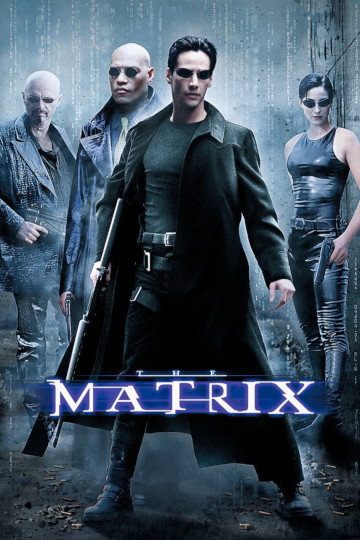
When I gave this talk, I warmed up the crowd by asking the audience who liked the 1999 film The Matrix. Roughly half raised their hands. But the kicker was the followup question, "who has never seen this movie?". 10 brave youngsters raised their hands to audible gasps.
In this movie, there's an iconic moment where our hero, Ted "Theodore" Logan, is presented with two choices, the red pill or the blue pill.
The question is essentially "Do you want to know an uncomfortable truth?"; the blue pill means "no" and the red pill means "yes".
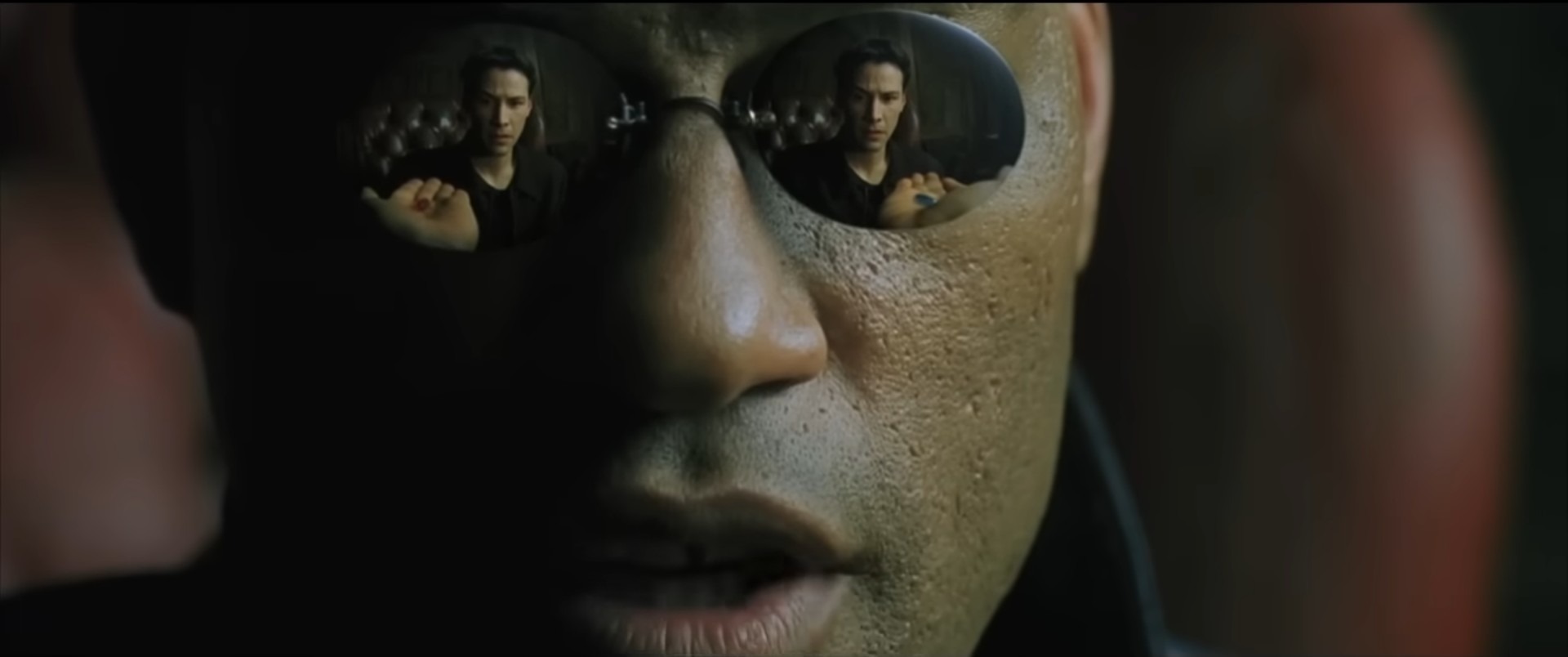
To the audience, the answer is obvious. If the main character chose blue, the credits would roll before anything happened. But the metaphor is so strong and the cinematography kicks so much ass that the scene influenced our culture and language to the point where people who haven't even heard of the film say the phrase "based and red-pilled".
Let's talk about the "black pill".


It comes from "incel" culture. The word is a portmanteau of "involuntary" and "celibate". Basically, young men who had trouble dating started complaining about it together on the Internet. So far, so good, but an unfortunate feedback cycle emerged. Those who used the space in a productive manner, such as brainstorming, encouragment, mentorship, etc., tended to shape up, mature, work through their problems, and, to put it bluntly, get laid. At that point, they didn't really feel like sticking around and commiserating anymore, so they left. This was a natural filtering process. Thus, when new, impressionable youngsters entered the community, they were greeted only by miserable, hopeless, antisocial losers. Over time the culture became so toxic that the accepted wisdom became, essentially, "Give up. The game is rigged. There is nothing you can do. You might as well lie down and rot."
In short, the "black pill" is nihilism mixed with depression mixed with anger, and in the worst case leads to outcomes like suicide or school shootings.
I almost fell into this trap. Speaking from experience, entering the dating scene as a young man can be challenging to the point of despair. I was raised by conservative Christian parents and had so, so much to learn and to unlearn about the world in order to date comfortably and confidently.
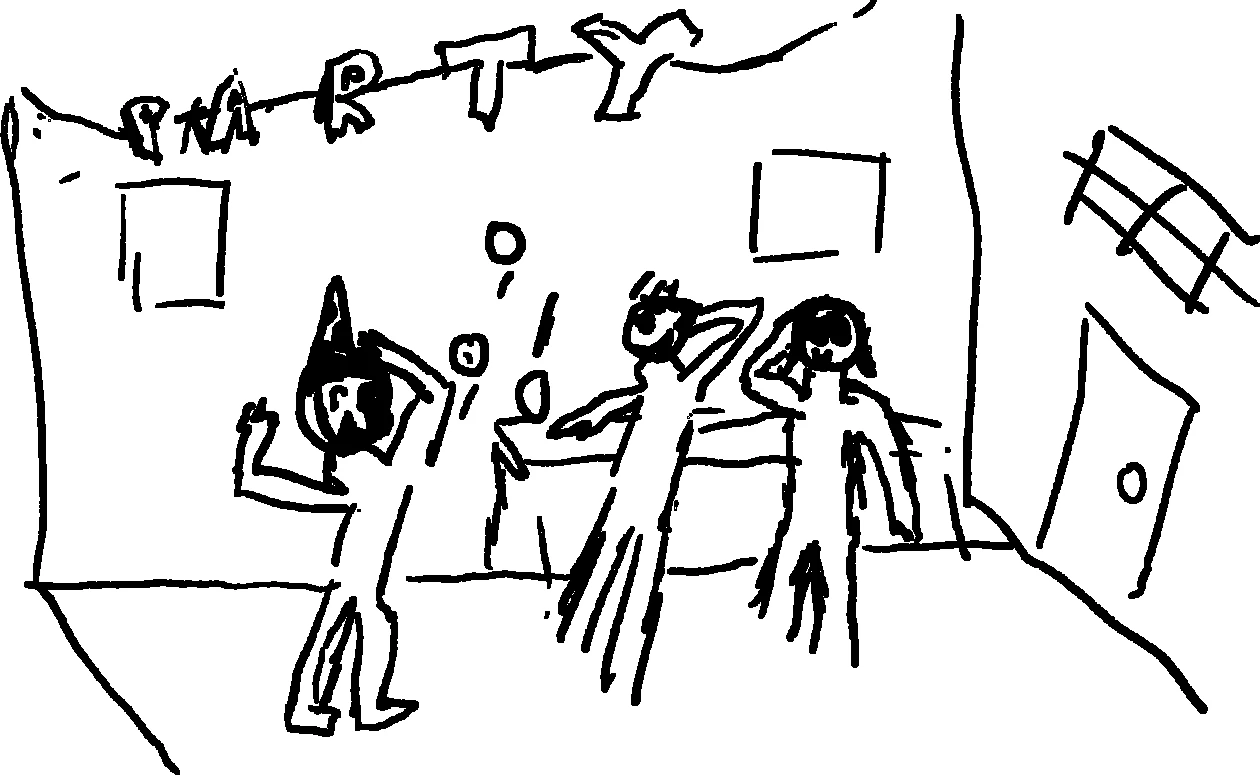
Perhaps you may be surprised to hear this but what helped me get out of this spiral was listening to pick up artists. Looking back, I think what these guys mainly have to offer is its own form of nihilistic, manipulative toxicity, but one of them said something that I instantly realized was key. He said that you shouldn't focus on the outcome of "the pick up". The actual move, he said, is to work on being attractive, in general, to everybody. Platonic friends included. You should try to make everyone want to be around you, because you genuinely care about them. Listen intently to what they say. Make them laugh. You offer people whom you interact with meaningful experiences that make them remember you and invite you to future events. You put effort in to make everyone have a good time. By doing this, you create more circumstances where there is a chance for romance to spark. It's genius!
My takeaway here is that the kids are alright. Even when exposed to a bunch of bad ideas, if good ideas are also in the mix, they'll figure it out.
Let's bring this a little closer to home.
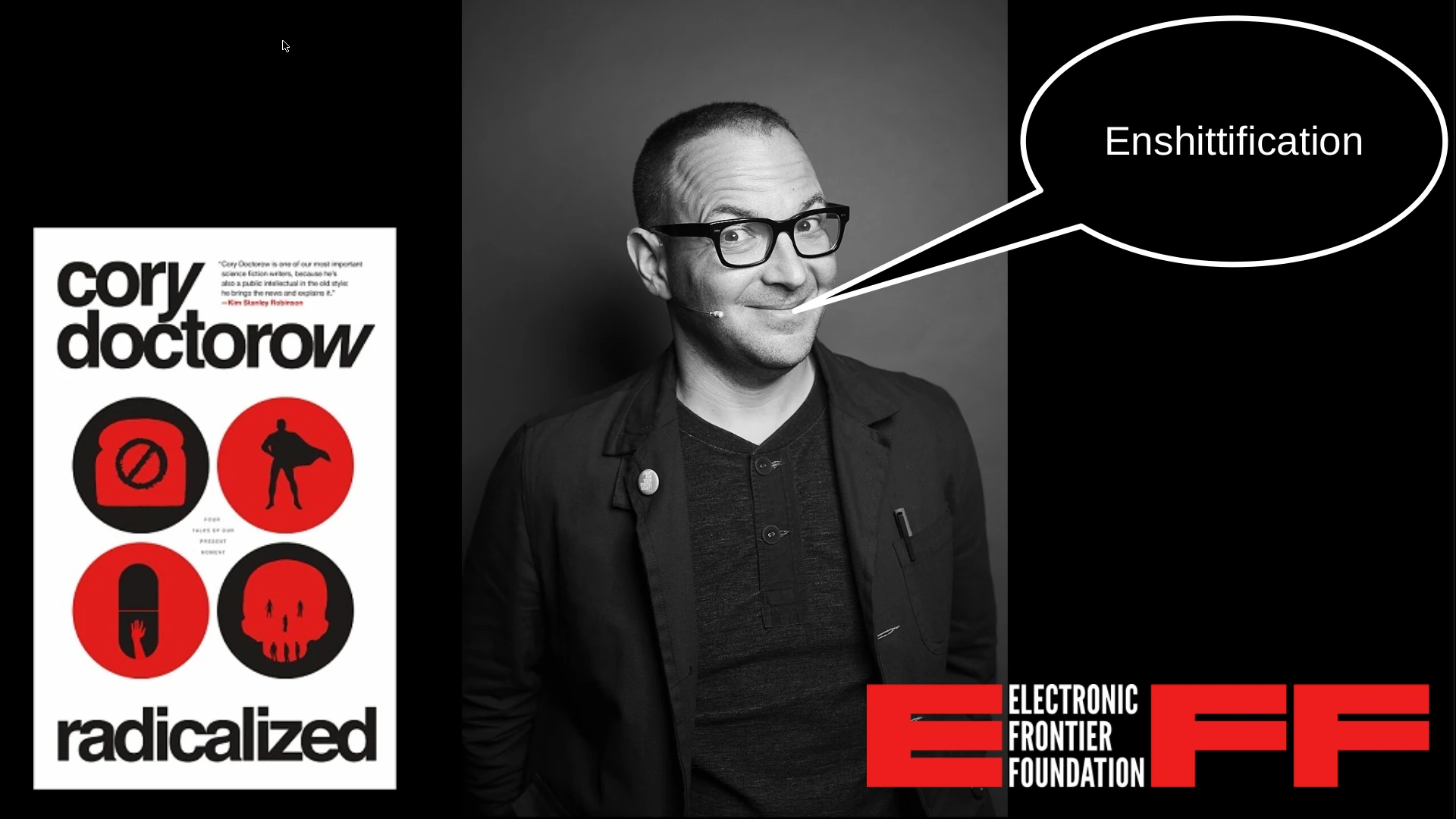
This is Cory Doctorow. He's the guy who coined the term "Enshittification". He worked for Electronic Frontier Foundation for a while before becoming a fulll-time writer. In 2019 he published a short story called "Radicalized". The story centers around an online forum of people who commiserate together because they got screwed over by heath insurance companies. Listen to this excerpt and see if it sounds familiar:
In a forum for ex-drunks, there’s a big group of elder statespeople who’ve been sober for years and years. They’re a wise, moderating voice, and they are the existence of proof of life after addiction. Whenever someone on the forums went on a bender and was recriminating with themselves, there was a dried-out elder who could tell a story to top theirs, about being put out on the street, losing their kids, losing their limbs, even, and coming back from it.
Fuck Cancer Right In Its Fucking Face did not have those people. The people who got over their furious grief left [the forum], chased away by its rage culture. The people who stayed were really into their anger, clinging to it like a drunk refusing to let go of a bottle.
If your anger took you to a place you couldn’t handle, a place that scared you, the elders of [the forum] would help you all right: they’d explain to you that this was the right reaction, the only reaction, and it was never, ever going to get better. This was your life from here on in.
Five years after Doctorow published this fictional short story, the real life CEO of the American health insurance company UnitedHealthcare was shot to death, bullets cased with the words "deny, defend, depose".
Part 2: Software Should Work
The main purpose of a conference like this is technical. At its core, it's a "safe space" where the attendees already agree that software should work, and it should be fast, and it should prioritize the user experience, and so all we have to do is share tips, tricks, demos, and research with each other on how to better accomplish these things.
But if we neglect the meta examination here, our efforts are in vain. The implication of the phrase "software should work" is that often in the real world, we find that it doesn't work.
Right?
Why not?
What's stopping software from working?
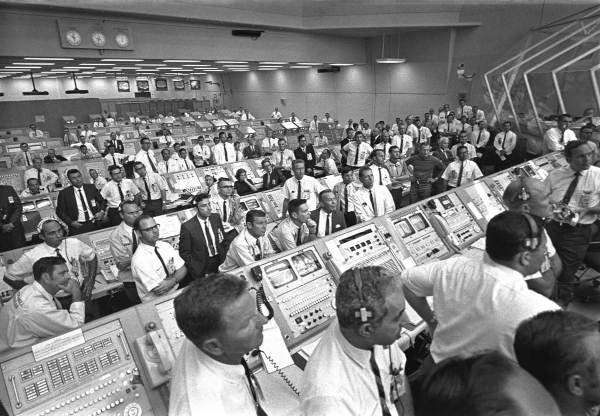
Is the problem simply ignorance?
Are programmers not programming hard enough?
Is the software engineering field too nascent?
Have we not discovered how to make robust software yet?
I would argue that mankind discovered how to make robust software before I was even born. There's a case to be made that the overall robustness and performance of software has decreased since then, despite hardware being many orders of magnitude more capable.
What gives?
Have you, dear reader, ever attempted to make software work better at a company you worked for as an employee or contractor, and you were shot down by management, saying that the business had other priorities?
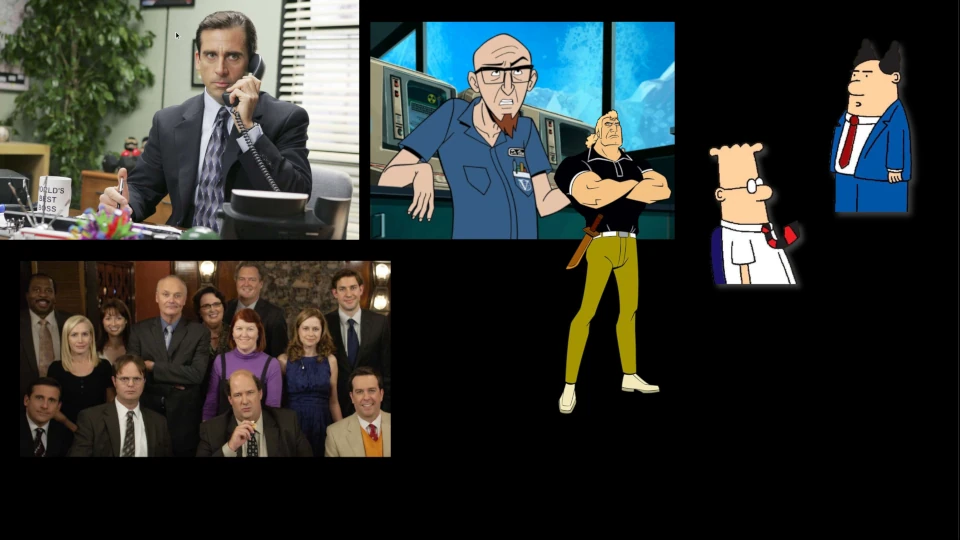
You know the kind of relationship I'm talking about. Management is Pointy Haired Boss, and you're Dilbert. Management is Rusty Venture, and you're Brock Sampson. Management is Michael Scott, and you're...any other character from The Office.
The reality is that we software engineers already have a strong drive to make software work well, but there is a non-technical opposition.
Let's talk about Benevolent Noncompliance: a form of rebellion where the beneficiary is also the authority.
Asking for forgiveness rather than permission. When I gave this talk at SSW '26, about 75% of the audience fessed up to having done this (including myself).
Secrecy. Normally you want to claim credit for doing good things at work. But sometimes we find ourselves doing the necessary things to make the business run smoothly in full secret, knowing that if management found out they would actually stop it.
Inception. You have a meeting with management, and fool them into believing they have come up with an innovative, brilliant solution to the problem you bring to their attention. Of course, this "innovation" just so happens to be exactly what you carefully planted in their head during the meeting.
Misdirection. Management wants to argue with you about something so whenever you do important work, you time it to coincide with less important work that you intentionally create more fanfare around. Management takes the bait and gets involved in the trivial distraction work, leaving your important work alone. It's kind of like giving your child a Fisher Price toy oven so they stop fucking around with the hot stove and burning themselves.
The "duck". You intentionally put an obvious problem for management to identify and claim credit for removing, again leaving your important work alone. As the lore goes:
The artist working on the queen animations for Battle Chess was aware of this tendency, and came up with an innovative solution. He did the animations for the queen the way that he felt would be best, with one addition: he gave the queen a pet duck. He animated this duck through all of the queen’s animations, had it flapping around the corners. He also took great care to make sure that it never overlapped the “actual” animation.
Eventually, it came time for the producer to review the animation set for the queen. The producer sat down and watched all of the animations. When they were done, he turned to the artist and said, “that looks great. Just one thing - get rid of the duck.”
Of course, all of these amusing tricks are alternative coping mechanisms to either quitting, confrontation, or acceptance. Consider that all of these, other than accepting your fate to create subpar software, are gambles. If you be tricky, you risk getting caught and reprimanded, possibly fired without severance. If you quit, you endure stress and uncertainty in the job market. If you confront management, you risk silent retaliation and loss of political advantage within the company.
Now consider how the job market affects this dilemma. When the supply/demand ratio favors software engineers, we enjoy stronger negotation power. Rather than being afraid of getting fired, our managers are afraid of us quitting.
When computers were first invented, we drew incredibly strong negotiation power from the scarcity of fellow programmers. But now the free market is catching up with us, and we face the same struggle as workers of other industries. We are learning that software quality was maintained only through the will of software engineers combined with their accidentally strong negotiation position in the job market.
Part 3: Agency
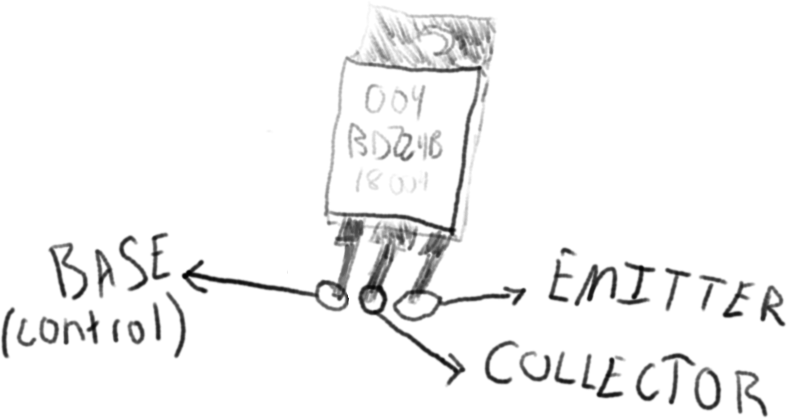
This is a transistor - the fundamental unit of modern electronics.
The key concept here is that it's an automated switch. Even just a teeny weeny smidge of voltage into the base terminal controls whether a relatively large current flows through the other two terminals.
We practically worship these things.

It's beautiful because it is both literally how computers work at a microscopic scale, and also metaphorically what they do at a macro scale. It is a mechanism by which something weak controls something strong; a device where an arbitrary amount of power is wielded by an effortless indication of intent.
But who gets to decide whether "true" or "false" is sent into the base terminal?
Whom does the software serve?
This is something that I would like to try to help non-tech-savvy people be a little bit more savvy about.
For example, when I run a browser on my computer, that's literally called a "user-agent". The browser is acting on my behalf; it serves my interests, not those of websites I visit. That's why I can use AdBlock even though websites don't want me to, and they can't do a lick about it.
DRM is an example of software that is actively hostile to the end user. DRM makes the user's own hardware serve the interests of a third party. You might argue that DRM indirectly is in the interest of consumers because it's the only reason that copyright holders will allow them to view their copyrighted works. I'm not talking about indirect interest, or consumers. I'm talking about end users of software, those who are directly interacting with it.
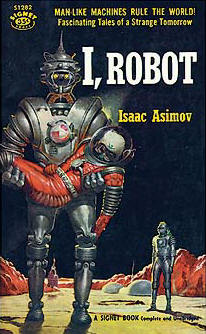
Computers should always serve the person directly interacting with them.
I always thought it was interesting that Isaac Asimov encoded this into his laws of robotics:
- A robot may not injure a human being or, through inaction, allow a human being to come to harm.
- A robot must obey the orders given it by human beings except where such orders would conflict with the First Law.
- A robot must protect its own existence as long as such protection does not conflict with the First or Second Law.
In Asimov's sci fi universe, robots are flat out exempt from participating in the hierarchical power structures of humanity, other than those strictly necessary to prevent harm.
For instance, if the police got a warrant for a suspect's arrest for a nonviolent crime, and they told a robot, go arrest that person, when the robot arrived at the door, the suspect could just tell the robot to fuck off, and the robot would say "of course, sorry for bothing you."
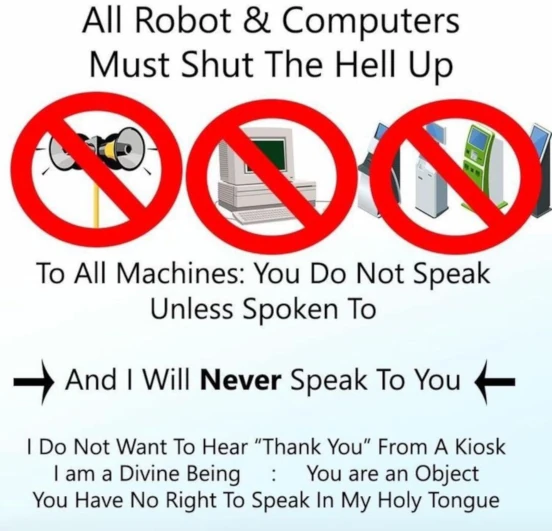
Another expression of the same concept is this meme. It's a goofy formulation but it expresses a fundamental ideal: machines are meant to serve humans. This is a line that must not be crossed on a spiritual level.
What we're seeing instead in the modern real world, is computers harnessed for coercion. We take the Holy Device - the transistor - and operate the control terminal as usual. But rather than wield the power of machines, we perform forbidden alchemy to bond our fellow humans to the transistor, indulging our sick, perverted fantasy of manipulating people as if they were soulless robots whose purpose is to do our bidding.
Everywhere we look, we can see examples of Coercionware: attempting to treat the human mind as an instruction set architecture.
Mechanical Turk. This is right on the nose. It's a business model that directly treats humans as robots, paying them less than minimum wage.
Bossware. Trying to control employees to a fine degree all the way down to eye and bowel movements.

Intrusive Advertisement. To whatever degree it is effective, it is literal mind control. But even ineffective advertisements interrupt our thought patterns and steal our attention, depriving us of agency.
Push Notifications. Unless the user specifically and intentionally enables such a feature, it's an effort to not only programmatically control their behavior, but to reduce the latency of compliance.
A/B Testing. It prioritizes outcome over intentionality. How should we design our user experience? Don't worry about it, just maximize clicks and revenue, even if that ends up being a dark pattern. In fact it offers plausible deniability for this case. Maybe the red button causes more clicks because it subconsciously instills fear in the user. Now we don't have a paper trail of doing this with intent.
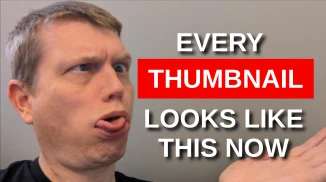
YouTube. Both content creators and viewers are being controlled by "the algorithm". Content creators are forever stuck chasing the ephemeral preferences of the algorithm, often at the expense of the integrity of their content. Have you ever noticed how modern YouTube thumbnails are evolving to look like this? Meanwhile on the viewing side we have absolutely absurd concepts like "Crunchy-to-Alt-Right Pipeline". What in the actual fuck kind of Chthulu hell portal have we opened, that this is a thing?

AI Agents. Sleight of hand. AI agents purport to serve the user, but in reality the agency they serve is that of the AI company who controls the model and the closed source software surrounding it. If you don't control the source code, you are not in control.
Dark Patterns. These are just openly coercive, not much to say here. It is mindblowing to me the degree to which computer users regularly tolerate this outright hostility.
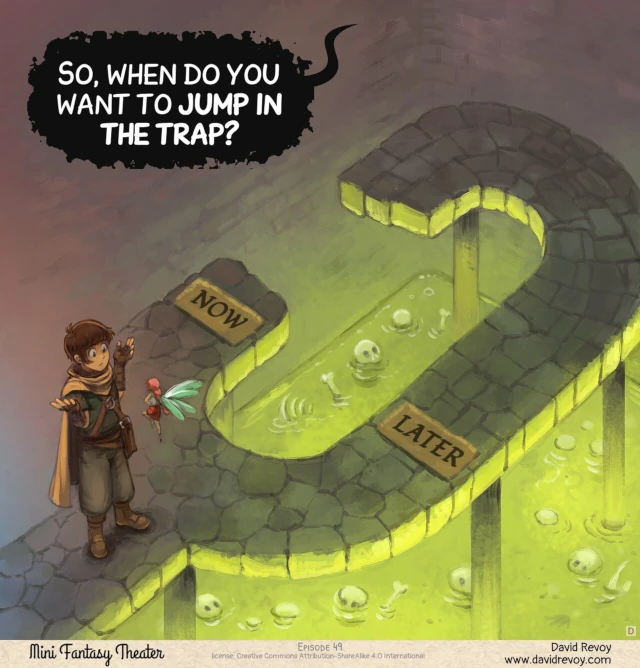
Doomscrolling. This is software that maximizes engagement by using content algorithms and infinite scroll. It keeps users glued to the screen and accustomed to consuming content chosen for them. To be clear, most people when they say "doomscrolling" are talking about a bad habit, e.g. they used Facebook too much on one particular day. I'm saying that the user-facing software of Facebook is categorically, fundamentally coercive. It's like an arbitrary code execution exploit running on our brains. Scrolling down is the program counter, and the content that pops up is the instructions.
A weird side effect of this is that it means our brains can get hacked, just like computers. Although the content selected by the algorithm is intended to serve the company which is providing the software, it leaves our brains also vulnerable to malicious third parties.
President Vladimir Putin ordered an influence campaign in 2016 aimed at the U.S. presidential election. Russia's goals were to undermine public faith in the U.S. democratic process, denigrate Secretary Clinton, and harm her electability and potential presidency. We further assess Putin and the Russian Government developed a clear preference for president-elect Trump. We have high confidence in these judgments.
No matter what your political leanings are, if you value democracy, this should be alarming.
The primary methodology used was a state-sponsored troll farm waging a social media campaign. It's really not far-fetched to say that we were mind-hacked, and that the vulnerability stems from the manipulative software practices of social media, and that the vulnerability has not been patched, and is still being actively exploited.
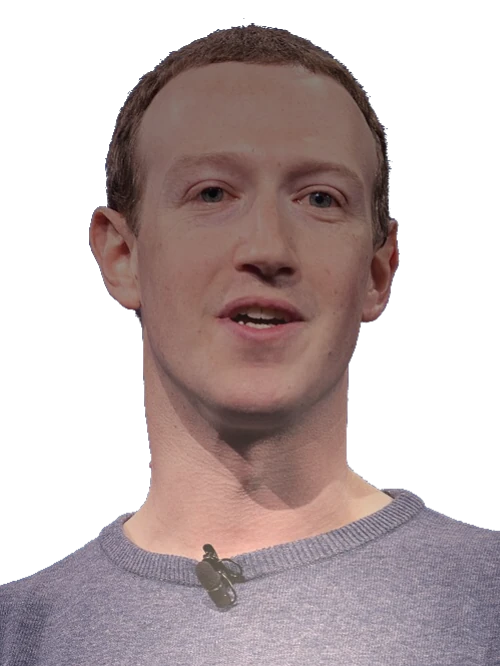
No one is even working on a fix. Certainly not this guy:
I think the idea that fake news on Facebook influenced the election in any way, I think is a pretty crazy idea.
Each year that goes by, it gets more difficult to be an empathetic person who loves computers. Seeing the potential for what software could be doing for humanity versus the stark reality developing before our eyes is depressing. It can feel hopeless. Sure, we want things to be different, but is there actually anything we can do? It seems like every day we're being asked to "call our representative" or sign a petition or deal with the next emergency. We're always losing ground, never getting anything back.
"I'm tired, boss."
Our agency is under attack from all sides, and we're losing even the ability to opt out as more of our society becomes integrated with software. I lost touch with an entire group of friends because they exclusively do their event organization on Discord.
The black pill offers relief in the same way that submission offers peace. To take the black pill is to relinquish the magic of computers, and surrender to their oppression.
I would like to call attention to some black-pilled takes that I've seen in the wild. I want to be crystal clear here: the point is not blame or shame, but empathy. Even the last one. These are examples of attempts to cope with a very real sense that something is wrong.
Let's start with a low stakes one.
"Computers were a mistake."
Sigh. I find it aggravating when a fellow programmer says this. I hear this occasionally from people who have not only made their entire career out of programming but also made it their primary hobby. I understand that they're just being edgy, it's supposed to be a tongue-in-cheek, it's a self-aware joke. But in my head I'm screaming, you are the one making computers do stuff! It denies all agency.
Using AI even though you don't like it, or in a way that you find distasteful, because you think you have to. If you legitimately like to use AI, it's a different story. But I've seen way too many blog posts of people describing the joyless way in which they've begrudgingly started using it at work and how it makes them depressed but this is their new reality now. I have a friend who manages a team of people who told me that they are working 50+ hour weeks, using AI to try to eliminate the jobs of other teams at the same company, out of fear that if they don't do it, it will happen to them.

Another one is Anubis. We've all seen this pop up right? It's web scraping deterrence software. I know it's being used by Linux kernel mailing list, Codeberg, FFmpeg, Wine, and a few other things.
Some people take issue with the fact that the default configuration has an image of an anime girl mascot. Honestly I feel bad for those people. Imagine living such a bland, colorless existence that this cutie is offensive. They probably think ketchup is spicy.
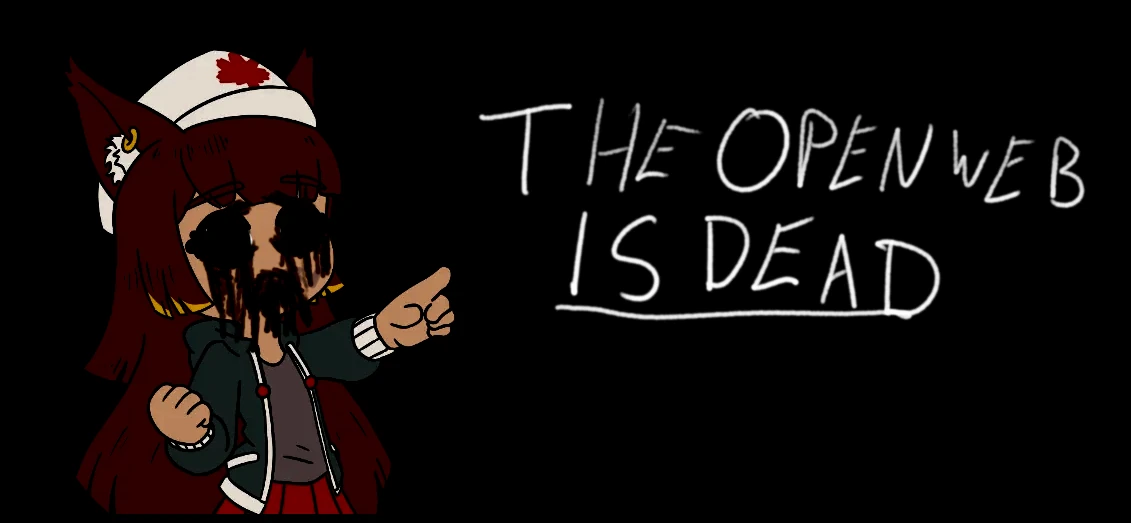
On the other hand, I find deployment of the software, at its core, depressing, because of its "salt the earth" approach. It changes something that should be computationally cheap and anonymous - visiting a website - to being, by design, an order of magnitude more expensive. It breaks forum link previews, it depletes batteries, it removes the option for the visitor to disable JavaScript, and it excludes bots from accessing the web for legitimate reasons. It whispers bitterly in your ear, "there is no winning. There is only deferred loss" as it surrenders the open web without a fight.
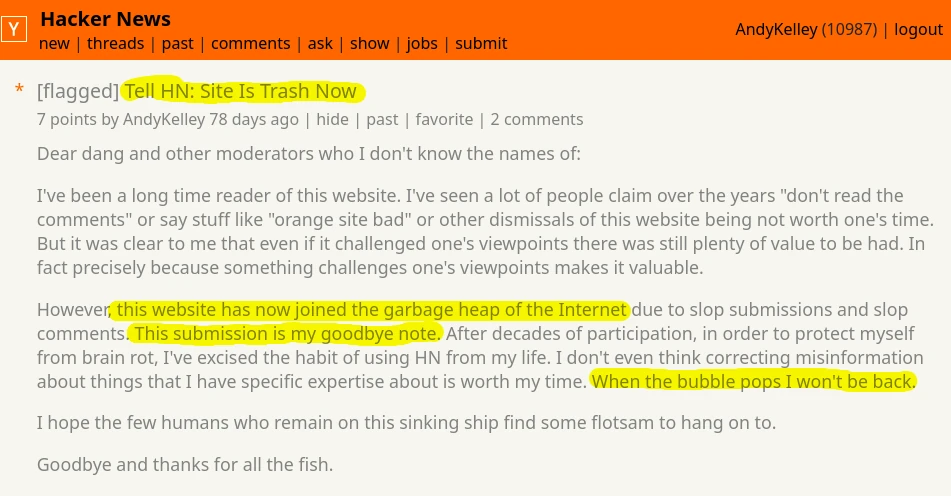
Next we have... myself! This is a screenshot of me declaring, on Hacker News, "The Site Is Trash Now" which I'm not gonna lie is a pretty black-pilled take. Go ahead, you can have a laugh at my expense. It's melodramatic, I know. But also, this comes from a real place. It saddens me that the value I used to derive from this website is eroding.
Another pattern I've seen recently is people giving up on Free and Open Source Software out of disillusionment, particularly due to AI companies. They'll say things like, "the joy is gone. I'm not going to share my code anymore because it'll just get scraped and used to build the next LLM." To me this is completely missing the point, which is to pool effort in order to ensure that, in general, users of software remain in control of that software. To this end, it doesn't really matter if your code gets picked up by AI companies. It primarily matters whether high quality Free Software is available to users, providing competition that limits the degree to which proprietary software can get away with being coercive. If you refrain from participating in the software of the commons, the only thing you're doing is surrendering more of our collective agency to abusive, centralized powers.
Finally we have dismissal of ethical considerations with the excuse "if I don't do it, someone else will". Deep down, we know that some lines should never be crossed. But this kind of fatalistic thinking sends our moral compass spinning and erases our willingness to stand up for our beliefs.
Part 4: Faith
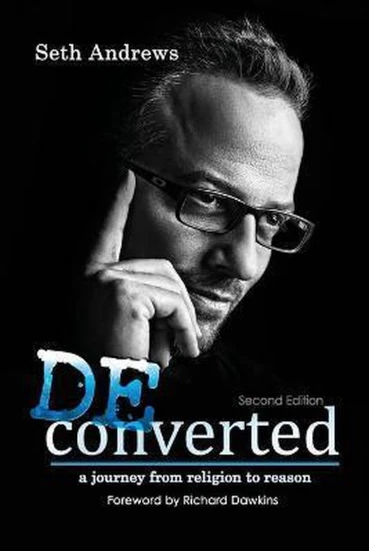
When I was a child my parents raised me to believe in Protestant Christianity. I didn't have a choice. Right and wrong was given to me as a package deal.
As I reached adulthood, I started to untangle that upbringing little by little. The process is called "deconversion", and it takes many years. For some, a lifetime. If you have a similar background as me, or you're curious to learn more, I recommend the audio version of this book which is narrated by the author, Seth Andrews. He has a really nice voice.
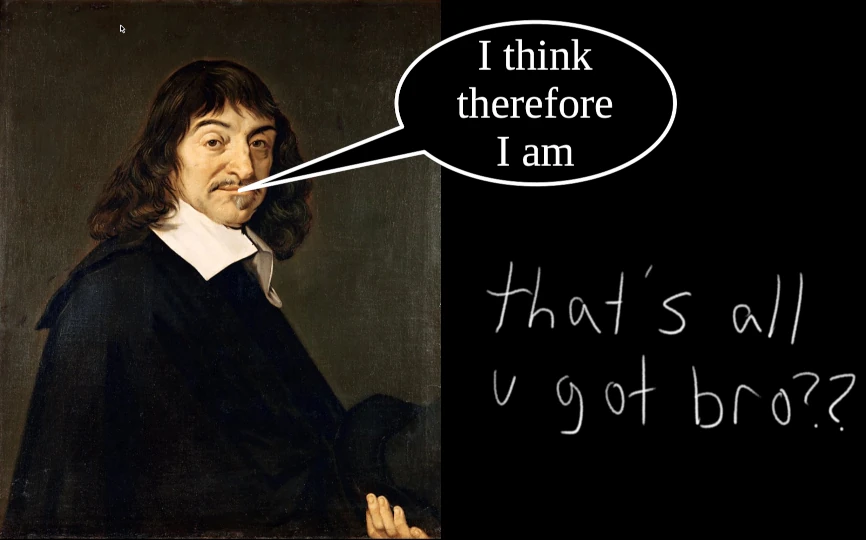
One of the challenges deconverts must face is forging a morality framework. You can't derive right and wrong from nothing. If you try, you'll get stuck at "I think therefore I am". Philosophically, there is nothing beyond this that can be proven without introducing a core, foundational premise.
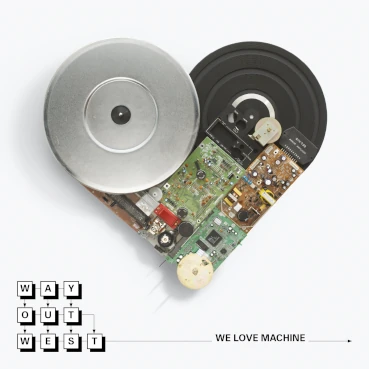
We are technologists. We love machine.
As technologists, our role is to accelerate humanity along its current trajectory. The same technology can be a force for Good or a force for Evil depending on who wields it. Nuclear energy as it exists today is literally the controlled explosion of an atomic bomb. The fruit of our labor is indiscriminate multiplication of the path humanity is already walking. Thus, if humanity is Good, then technology is Good. And if humanity is Evil, then technology is Evil.
This is why we must believe that humanity is generally Good.
Otherwise, what are we even doing?

This is Stanislav Petrov. In 1983, during the Cold War, his job was to monitor an early reporting system for attacks and notify his superiors for immediate retaliation. On September 26th, the system reported five missiles had been launched by the United States. Thinking quickly and critically, he suspected it to be a false alarm, and disobeyed orders, disregarding Soviet military protocol to wait for an additional confirmation. (source)
The confirmation never came. It was indeed a false alarm in the computer detection system. Had he followed protocol, it's very likely that his superiors would have launched an assault against the United States, triggering an all out nuclear war.
Later in an interview, Petrov said that he was never absolutely sure that it was a false alarm. He said he thought the odds were 50-50. Can you imagine what he must have felt in that moment? Think of the sheer magnitude of risk that he bore to disregard protocol.
50-50. That means when it came down to it, he made a choice based on something other than the evidence before him. He chose to believe that mankind is Good. He chose faith in humanity.
Part 5: Youth
This is the cover art for Ninajirachi's debut full length album, I Love My Computer. Take a moment to let it wash over your neurons...

If this tickles your curiosity, do yourself a favor, go watch her music video for Infohazard, then come back.
...
...
...
Welcome back. I know, right?!
I don't know how this hits for other generations, but for millenials like me, there's just something about Ninajirachi's art that strikes a chord. I'll do my best to put it into words for you.
This is someone who still believes in the magic of computers. She captures and evokes precious, nostalgic feelings that I have deep within me from when I was growing up and discovering that magic for myself. But she's one decade younger than me, so you can see the modern web on full display. In this very article I complained about YouTube and Discord, while they're featured prominently in that music video. I don't think I'm wrong to call out dark patterns where I see them, but at the same time, I've lost something along the way.
Young people lack the wisdom that comes from hardship. They fall for scams, uncritically participate in corporate viral marketing campaigns specifically aimed to take advantage of them, believe improbable things, and take risks that could lead to permanent harm. They try stuff that, to an older person, is obviously going to fail. This is because they are not yet jaded. Their belief system has not yet been scarred by living in this world. They lack the coping mechanisms that older people have developed over time to avoid getting hurt the same way over and over again. This is both a blessing and a curse. Older people are more adapted to living in the real world, but young people are more driven to change it. We need the wisdom that comes with age, but we also need the blind eagerness of youth, the willingness to try again something that has already failed a million times. We need unfettered optimism; the ability to find joy even in the wasted ruins of what was once a great city.

There's a scene from Hunter x Hunter where the main protagonist, a 12 year old boy who goes out adventure seeking, faces a betrayal so devastating, that he ages 10 years on the spot in order to gain the power necessary to defeat his adversary. It's an extremely powerful scene. His despair is too great to bear, and when he turns to apathy as a coping mechanism, his body literally transforms into an adult. It depicts in a singular moment, what typically happens to us gradually over time.
Our task, as the older generation, is to shield the youth from those who would exploit their naïveté, without infecting them with our own accumulated pain and cynicism.
I'll leave you with one final message, addressed to people of all ages, whether you are younger than me, a peer, or my elder.
We don't have to take it lying down.
Next time you're feeling alone, count your allies: VideoLAN Organization, Blender Foundation, Software Freedom Conservancy, Electronic Frontier Foundation, Linux Foundation, Signal Foundation, KDE e.V., the PostgreSQL Community, the Debian Community, and so, so many more.
Just look at how eager people were to come together, even from places as far away as Greece, for the inauguration of a conference with a manifesto as simple as "software should work".
"I wish it need not have happened in my time," said Frodo.
"So do I," said Gandalf, "and so do all who live to see such times. But that is not for them to decide. All we have to decide is what to do with the time that is given us."
J.R.R. Tolkien, The Fellowship of the Ring
The battle against Coercionware is only beginning, and we find ourselves on the frontlines whether we like it or not, because we are the ones who make computers do what they do.
But we are not alone, and computers truly are magic. Do not mistake lost ground for lost hope. We can win this thing if we collectively choose to believe it and bet on it.
All in.